
Vancouver, British Columbia–(Newsfile Corp. – November 19, 2026) – Cabral Gold Inc. (TSXV: CBR) (OTCQX: CBGZF) (“Cabral” or the “Company“) is pleased to announce results from an independently prepared updated Mineral Resource Estimate (“MRE”) for the Cuiú Cuiú project, Pará State, Brazil.
Highlights:
- Total Measured and Indicated Resources are 42.5Mt @ 0.73 g/t gold (998,800 oz), while the total Inferred Resources are 82.1Mt @ 0.95 g/t gold (2,512,900 oz). The totals represent a 49% increase in Measured and Indicated Resources and a 376% increase in Inferred Resources on previous estimates
- Open-pit oxide resources reported as part of the above total resources and amenable to heap-leach processing, are reported for all six deposits, containing total Measured and Indicated Resources of 21.6Mt @ 0.38 g/t gold (265,600 oz) and additional total Inferred Resources of 16.7Mt @ 0.39 g/t gold (210,900 oz)
- In addition, open-pit resources for the underlying primary or hard rock mineralization and reported as part of the above total resources, comprise Indicated Resources of 20.8Mt @ 1.09 g/t gold (733,200 oz) and Inferred resources of 65.4Mt @ 1.09 g/t gold (2,302,000 oz). Resources are contained within six gold deposits, all of which remain open at depth
- A significant amount of higher-grade primary material is contained within the current MRE. At a cut-off grade of 1.00 g/t gold, the primary, or hard rock resource comprises Indicated resources of 6.2Mt @ 2.32 g/t gold (463,200 oz) and Inferred resources of 19.1Mt @ 2.37 g/t gold (1,452,200 oz)
- All six gold deposits remain open at depth and several deposits including Central, PDM, Machichie and Jerimum Cima remain open along strike. There are over 50 peripheral partially tested and untested targets at Cuiú Cuiú that contain gold
Alan Carter, Cabral’s President and CEO commented, “The updated MRE for the Cuiú Cuiú district is a significant increase over the previous resource estimate and is another important milestone in the development of our project. Primary or hard resources have increased by 63% and now contain 733,200oz of gold in the Indicated category, whilst primary resources in the Inferred category have increased by 406% and now contain 2,302,000oz of gold since the previous resource estimate. Near surface oxide resources have also grown significantly over the previous resource estimate. Oxide resources in the Measured and Indicated category have expanded by 21% and now contain 265,600oz of gold, whilst oxide resources in the Inferred category have grown by 190% and now contain 210,900oz of gold. This growth in the oxide resource base is expected to have positive implications for expanding the Phase 1 heap leach operation in the near term.”
“The Cuiú Cuiú project is beginning to exhibit its true potential and now ranks as one of the largest gold projects, and the second largest undeveloped primary gold deposit, in Brazil. It is the largest gold project in the Tapajós region of Pará state by a significant margin. All six of the deposits identified to date are open at depth, and several are open along strike. Over 50 peripheral targets with gold in reconnaissance drill holes, surface trenches and boulder fields at Cuiú Cuiú remain untested or partially tested. I would like to thank and congratulate the entire geological team on this very significant achievement.”
Cuiú Cuiú Project
The Cuiú Cuiú Project is located within the Tapajós Gold District, approximately 195 kilometers (“km”) south-southwest of Itaituba, within the state of Pará in northern Brazil. The Project is well connected to the BR-163 highway located 60km to the south-east by a network of recently upgraded roads. Cabral Gold has a 100 percent (“%”) interest in a total of 30,563 hectares covering the district. Exploration to date has resulted in several discoveries including the six deposits mentioned herein (Figure 1) as well as 50+ additional targets currently under exploration.
Cabral is pursuing a two-phase development strategy at Cuiú Cuiú. Phase 1 is a 3000 tonne per day (“t/d”) heap leach operation and open pit mine capable of mining and processing gold-in-oxide saprolite ore equivalent to 1 million tonnes (“Mt”) per annum. The mine is ramping up to commercial production and announced its first gold pour on September 10, 2026. The Phase 2 development will focus on the much larger primary or hard rock resource. Both oxide and primary resources are updated as part of this press release.
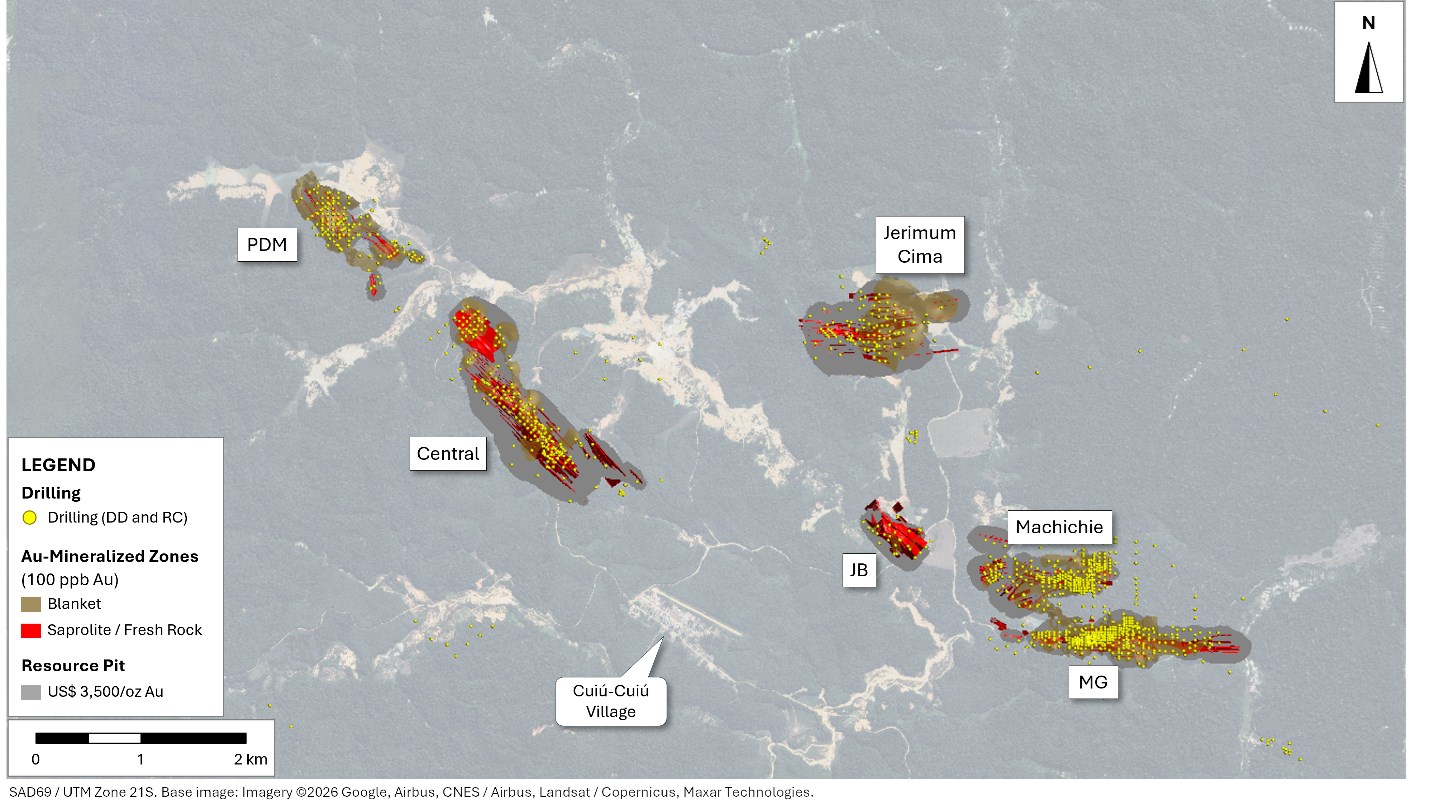
Figure 1: Location of current gold resources within the PDM, Central, JC, JB, Machichie, and MG deposits.
The location of the village of Cuiú Cuiú is also shown
To view an enhanced version of this graphic, please visit:
https://images.newsfilecorp.com/files/3900/324856_c7d1bb7de493fae0_002full.jpg
Mineralization within the district is hosted primarily in granitic and dioritic intrusive rocks, in quartz stockwork and breccia zones surrounding high-grade veins filling linear subvertical structures. An upper zone of weathered and oxidized material averaging 60m in thickness from surface, highly amenable to heap leaching, overlies the primary intrusive-hosted gold mineralization.
Mineral Resource Estimate
The MRE covers six gold deposits within the central part of Cuiú Cuiú district: MG, Machichie, Central, PDM, JB and Jerimum Cima. Several other targets have economic drill intercepts including Morro da Lua, Machichie SW and Central SE, but currently have insufficient drilling to be included in the current MRE update.
Total resources are reported in terms of near surface oxide resources and primary or hard rock resources. Measured and Indicated Resources are 42.5Mt @ 0.73 g/t gold (998,800 ounces (“oz”), while the total Inferred Resources are 82.1Mt @ 0.95 g/t gold (2,512,900 oz) (see Table 1). The total resources represent a 49% increase in Measured and Indicated resources and a 376% increase in Inferred resources over the most recent previous resource estimates for oxide and primary resources.
Open-pit oxide resources amenable to heap-leach processing are reported for all six deposits, containing total Measured and Indicated resources of 21.6Mt @ 0.38 g/t gold (265,600 oz) and additional total Inferred resources of 16.7Mt @ 0.39 g/t gold (210,900 oz) (Table 1).
Mineral resources for the underlying primary or hard rock mineralization at Cuiú Cuiú comprise open pit Indicated resources of 20.8Mt @ 1.09 g/t gold (733,200 oz) and Inferred resources of 65.4Mt @ 1.09 g/t gold (2,302,000 oz) (Table 1). All of the six gold deposits included in this MRE remain open at depth and several deposits including Central, PDM, Machichie and Jerimum Cima remain open along strike.
| Resource Type | Category | Cut-off grade | Tonnage | Grade | Oz gold |
| g/t | Mt | g/t | thousands | ||
| Oxide | Measured | 0.10 | 0.5 | 0.84 | 13.6 |
| Indicated | 0.10 | 21.1 | 0.37 | 252.1 | |
| Measured and Indicated | 0.10 | 21.6 | 0.38 | 265.6 | |
| Inferred | 0.10 | 16.7 | 0.39 | 210.9 | |
| Primary | Indicated | 0.35 | 20.8 | 1.09 | 733.2 |
| Inferred | 0.35 | 65.4 | 1.09 | 2,302.0 | |
| All | Measured and Indicated | 42.5 | 0.73 | 998.8 | |
| Inferred | 82.1 | 0.95 | 2,512.9 |
Table 1: Summary of Cuiú Cuiú District 2026 Mineral Resource Estimate.
Notes:
- Mineral Resources are classified following the CIM Definition Standards (2014) and reported inside Lerchs-Grossmann pit shells using a long-term gold price of US$3,500/oz Au.
- Mineral Resources are estimated at a cut-off grade of 0.35 g/t Au for open-pit primary-rock mineralization and 0.10 g/t Au for oxide heap leachable mineralization.
- Metallurgical recovery used is 85% for saprolite/blanket material, and 96% for primary rock.
- Numbers may not add due to rounding.
- Mineral Resources that are not Mineral Reserves do not have demonstrated economic viability.
The Mineral Resource Estimate is based on 149,835m of diamond drilling and reverse circulation (“RC”) drilling (Table 2). Of this total, 604 drillholes for 46,118m have been completed since the 2022 MRE. A significant number of these drill holes were shallow RC holes which allowed for detailed geological characterization of the oxide mineralization. This is particularly important as this material is currently being exploited during the initial stages of the Phase 1 mining operation.
| Deposit | # Drillholes | Metres |
| Moreira Gomes | 592 | 43,742 |
| Machichie | 450 | 27,071 |
| Jerimum Baixo | 23 | 4,101 |
| Jerimum Cima | 265 | 18,430 |
| Central | 419 | 39,392 |
| Pau da Merenda | 271 | 17,099 |
| TOTAL | 2,020 | 149,835 |
Table 2. Number of drill holes and metres used in 2026 resource block models
The mineral resource estimate, effective November 11, 2026, was completed independently by VMG Consultoria e Soluções Ltda. (VMG), in accordance with National Instrument 43-101 (“NI 43-101”).
Gold-in-oxide Resources
Open-pit oxide resources amenable to heap-leach processing are reported for all six deposits at a cut-off grade of 0.10 g/t gold and comprise Measured and Indicated Resources of 21.6Mt @ 0.38 g/t gold (265,600 oz) and Inferred Resources of 16.7Mt @ 0.39 g/t gold (210,900 oz). These totals represent an increase of 21% in terms of Measured and Indicated ounces and a 190% jump in the Inferred ounces to the oxide resource base in just 16 months.
Table 3 shows the breakdown of oxide resources in the Measured, Indicated and Inferred categories by deposit type. MG is the largest of the oxide resources at Cuiú Cuiú comprising 26.6% of the total gold-in-oxide resources, followed by Central with 25.1%, Jerimum Cima with 20.2%, PDM with 15.7%, Machichie with 10.3% and JB with 2.0%.
| Deposit | Classification | Tonnes (Mt) | Au (g/t) | Au (koz) |
| MG | Measured | 0.5 | 0.84 | 13.6 |
| Indicated | 7.5 | 0.37 | 89.1 | |
| Measured + Indicated | 8.0 | 0.40 | 102.7 | |
| Inferred | 2.5 | 0.30 | 24.2 | |
| JB | Indicated | 0.1 | 0.35 | 1.7 |
| Inferred | 0.8 | 0.32 | 8.0 | |
| PDM | Indicated | 3.7 | 0.41 | 47.9 |
| Inferred | 2.6 | 0.32 | 26.8 | |
| Central | Indicated | 2.7 | 0.55 | 48.5 |
| Inferred | 6.1 | 0.36 | 71.3 | |
| Machichie | Indicated | 1.5 | 0.44 | 21.2 |
| Inferred | 1.5 | 0.58 | 27.7 | |
| JC | Indicated | 5.6 | 0.24 | 43.6 |
| Inferred | 3.3 | 0.50 | 52.9 | |
| Cuiú Cuiú | Measured | 0.5 | 0.84 | 13.6 |
| Indicated | 21.1 | 0.37 | 252.1 | |
| Measured + Indicated | 21.6 | 0.38 | 265.6 | |
| Inferred | 16.7 | 0.39 | 210.9 |
Table 3: Oxide resources by deposit and by class (2026 MRE) within the Cuiú Cuiú District.
Please refer to the Notes accompanying Table 1 for additional information
Primary (Hard Rock) Resources
Open-pit resources for the underlying primary or hard rock mineralization at Cuiú Cuiú comprise Indicated resources of 20.8Mt @ 1.09 g/t gold (733,200 oz) and Inferred resources of 65.4Mt @ 1.09 g/t gold (2,302,000 oz) (see Table 4). This represents an increase of 63% in Measured and Indicated ounces and a 406% increase in the Inferred ounces in the hard rock (primary) resource base over the previous 2022 MRE which has an effective date of July 31, 2022 (see press release dated September 30, 2022). Resources are contained within six gold deposits, all of which remain open at depth, and several deposits including Central, PDM, Machichie and Jerimum Cima remain open along strike.
Table 4 shows the breakdown of Primary resources in the Indicated and Inferred categories by deposit type. Central is the largest of the gold deposits at Cuiú Cuiú comprising 43.6% of the total primary resources, followed by Jerimum Cima with 22.3%, MG with 15.3%, Machichie with 12.3%, JB with 3.9% and PDM with 2.5%
| Deposit | Classification | Tonnes (Mt) | Au (g/t) | Au (koz) |
| MG | Indicated | 8.5 | 1.06 | 288.3 |
| Inferred | 6.7 | 0.82 | 177.2 | |
| JB | Indicated | 2.5 | 0.60 | 47.6 |
| Inferred | 3.6 | 0.61 | 70.6 | |
| PDM | Indicated | 1.2 | 1.39 | 52.4 |
| Inferred | 0.8 | 0.90 | 23.6 | |
| Central | Indicated | 5.0 | 1.22 | 198.3 |
| Inferred | 33.1 | 1.06 | 1,126.1 | |
| Machichie | Indicated | 1.9 | 1.30 | 78.6 |
| Inferred | 7.3 | 1.26 | 295.0 | |
| JC | Indicated | 1.8 | 1.18 | 67.9 |
| Inferred | 13.9 | 1.37 | 609.5 | |
| Cuiú Cuiú | Indicated | 20.8 | 1.09 | 733.2 |
| Inferred | 65.4 | 1.09 | 2,302.0 |
Table 4: Primary (hard rock) resources by deposit and by class (2026 MRE) within the Cuiú Cuiú District.
Please refer to the Notes accompanying Table 1 for additional information
Primary Resource Estimate – Cut-Off Grade Sensitivity
The average grade of the primary or hard rock resources, only within the limits of the 0.35 g/t Au resource pit shells, reflects a wide range of block grades. Table 5 below displays the robust nature of the gold deposits at Cuiú Cuiú at successively higher cut-off grades and indicates the presence of a significant amount of material of higher grade. This table does not include any of the oxide resources at Cuiú Cuiú.
| Cut-off grade (g/t) | Classification | Tonnes (Mt) | Au (g/t) | Au (koz) |
| 0.25 | Indicated | 27.2 | 0.91 | 793.8 |
| Inferred | 85.7 | 0.91 | 2,496.3 | |
| 0.35 | Indicated | 20.8 | 1.09 | 733.2 |
| Inferred | 65.4 | 1.09 | 2,302.0 | |
| 0.50 | Indicated | 14.7 | 1.38 | 651.0 |
| Inferred | 44.7 | 1.41 | 2,023.8 | |
| 0.70 | Indicated | 9.7 | 1.78 | 555.8 |
| Inferred | 30.1 | 1.80 | 1,749.2 | |
| 1.00 | Indicated | 6.2 | 2.32 | 463.2 |
| Inferred | 19.1 | 2.37 | 1,452.2 | |
| 2.00 | Indicated | 2.6 | 3.70 | 308.3 |
| Inferred | 7.0 | 4.08 | 922.0 |
Table 5: Primary resource grade distribution at different cut-off grades within the 0.35 g/t Au reporting pit. The Cuiú Cuiú MRE is in bold.
Please refer to the Notes accompanying Table 1 for additional information
Comparison with Previous Estimates
Table 6 compares the oxide, primary and total resources for the Cuiu Cuiu project with respect to the most recent previous estimates. Significant gains have resulted in both resource categories across primary and oxide resources.
| Ore type | Class | MRE’s 2022 + 2025 (Koz) |
MRE 2026 (Koz) |
Gain (Koz) |
Gain (%) |
| Oxide | M+I | 220 | 266 | 45 | 21% |
| Oxide | Inferred | 73 | 211 | 138 | 190% |
| Primary | M+I | 450 | 733 | 283 | 63% |
| Primary | Inferred | 455 | 2,302 | 1,847 | 406% |
| Total | M+I | 670 | 999 | 328 | 49% |
| Total | Inferred | 528 | 2,513 | 1,985 | 376% |
Table 6: Cuiú-Cuiú – Resource gains: MRE 2022 (Primary) + MRE 2025 (Oxide) vs MRE 2026 (Primary + Oxide)
Notes
- Koz = thousand ounces
- M+I = Measured and Indicated
- Primary resources at Cuiu Cuiu were last updated in 2022. The 2022 MRE was prepared by SLR and had an effective date of July 31, 2022. See the company’s news release dated September 30, 2022 for additional disclosure regarding the 2022 MRE
- Oxide resources at Cuiu Cuiu were last updated in 2025. The 2025 MRE and PFS study was prepared by Ausenco and had an effective date of July 23, 2025. See the company’s news release dated July 29, 2025 for additional disclosure regarding the 2025 MRE and PFS Study
- Please refer to the Notes accompanying Table 1 for additional information regarding the 2026 MRE.
Assumptions
Mineralization wireframes were initially generated in Leapfrog Geo using implicit modelling, based on composited gold assays at a nominal cut-off grade of 0.1 g/t Au and downhole structural measurements. Where necessary, the wireframes were subsequently refined in Micromine using conventional explicit modelling techniques, involving geological interpretation on cross-sections and subsequent linking of interpreted boundaries. Additional surfaces were constructed to delineate the boundaries between oxide and primary mineralization zones.
Block modelling was completed by VMG using Micromine software. The parent block size was 10 × 10 × 10 m, with sub-blocking to a minimum size of 1 × 1 × 1 m along wireframe boundaries. Gold grades were estimated using ordinary kriging, with search radii and search ellipse orientations determined through variographic analysis. Density values were interpolated using inverse distance squared (IDW2) where data quantity and spatial distribution were sufficient; otherwise, average density values were assigned.
VMG employed classical capping strategy to limit the influence of higher-grade outliers. Capping statistics were compiled for each deposit and each gold zone separately, resulting in assay top cuts or caps ranging from 2.5 g/t gold to 35.8 g/t gold.
All Inferred Resources, Indicated and Measured Resources are defined in accordance with the Canadian Institute of Mining, Metallurgy and Petroleum Definition Standards for Mineral Resources and Mineral Reserves (2014) (the “CIM Standards”). Mineral Resources were classified based on drill spacing, estimation parameters, geological continuity, and confidence in the geometry of the mineralized bodies. Measured Resources were defined in areas with a regular 25 × 25 m drill spacing, requiring a minimum of three drill holes and four composites, while Indicated Resources were defined in areas with 50 × 50 m or 100 × 50 m spacing, requiring at least two drill holes and two composites. Both categories were estimated using two-thirds of the search radius in their respective interpolation passes. The remaining estimated blocks were classified as Inferred Resources. Classification boundaries were defined using category-specific wireframes. Cabral corporate modelers and geologists reviewed the VMG models and created parallel validation models. Visual inspection of the block models versus the geology and assays was conducted by all parties.
Mineral Resources were calculated within Lerchs-Grossmann (LG) cones using MicroMine software considering open pit mining and a gold price of US$3,500/oz per ounce. Optimization parameters for the LG cones were based on actual and projected operating costs, recoveries, and pit slopes. LG cone parameters are presented in Table 7.
| Gold Price | US$/oz | $3,500 |
| Costs | ||
| Mining Oxide | US$/t (mined) | $1.75 |
| Mining Primary | US$/t (mined) | $2.50 |
| Processing Oxide | US$/t (processed) | $8.00 |
| Processing Primary | US$/t (processed) | $10.00 |
| G&A | US$/t (processed) | $1.00 |
| Operating Parameters | ||
| Mining Recovery | % | 95% |
| Mining Dilution | % | 3% |
| Gold Oxide Recovery | % | 85% |
| Gold Primary Recovery | % | 96% |
| Pit Slope Oxide | Degrees | 45 |
| Pit Slope Primary | Degrees | 55 |
| Royalties | % gross rev. | 3.25% |
| Refining / Transport | USD/Oz | $20.00 |
Table 7: LG Cone optimization parameters
Future Plans
The Company is continuing with aggressive drilling programs in terms of exploration and also resource development. A significant amount of infill drilling is planned for 2027 in order to upgrade the Inferred portion of the MRE.
Several of the gold deposits at Cuiú Cuiú, including Jerimum Cima, Machichie, Central and PDM remain open along strike, and all of the deposits identified to date are open at depth. Drilling over the next few months will also target potential extensions to the known deposits.
The Company has also initiated work on the potential to add additional near surface oxide resources amenable to heap leach processing, and also to upgrade the Inferred resources to the Measured and Indicated category.
Qualified Persons
The Mineral Resource Estimate was completed by VMG Consultoria e Soluções Ltda., Belo Horizonte, Minas Gerais, Brazil, under the direction of Volodymyr Myadzel, PhD, MAIG, a Qualified Person as defined by National Instrument 43-101, who was responsible for the Mineral Resource Estimate. Dr. Myadzel is independent of the Company and has verified the data disclosed including sampling, analytical, and test data underlying the drill results, using a variety of techniques including comparison against independently sourced assay certificates, site visit investigations, and digital based verification tests, and consents to the inclusion in this release of said data in the form and context in which it appears. Dr. Myadzel experienced no limitations with respect to data verification activities related to the Cuiu Cuiu project.
Technical information included in this release was supervised and approved by Brian Arkell, B.S. Geology and M.S. Economic Geology, SME (Registered Member), AusIMM (Fellow) and SEG (Fellow), Cabral Gold’s Vice President, Technical Services, and a Qualified Person under NI 43-101. Mr. Arkell has verified the data disclosed including sampling, analytical, and test data underlying the drill results, using a variety of techniques including implementing quality assurance/quality control (“QA/QC”) sampling measures, review and validation of the geological models, and review of the geostatistical approaches in the Mineral Resource estimation.
Technical Report
Further details supporting the technical and scientific information outlined herein, including the geological model, estimation procedure and block modelling will be available in a National Instrument 43-101 Technical Report authored by Volodymyr Myadzel, PhD, MAIG, of VMG Consultoria e Soluções Ltda. of Belo Horizonte, Minas Gerais, Brazil. The report will be posted under the Cabral profile at www.sedarplus.ca within 45 days from the date of this news release.
About Cabral Gold Inc.
The Company is a junior gold mining company engaged in the exploration, development and production from gold properties located in Brazil. The Company has a 100% interest in the Cuiú Cuiú gold district located in the Tapajós Region, within the state of Pará in northern Brazil. Six main gold deposits have so far been defined at the Cuiú Cuiú project which contain National Instrument (“NI”) 43-101 compliant Measured and Indicated Resources of 21.6Mt @ 0.38 g/t gold (265,600 oz) and Inferred Resources of 16.7Mt @ 0.39 g/t gold (210,900 oz) in oxide material. The project also contains Indicated resources of 20.8Mt @ 1.09 g/t gold (733,200 oz) and Inferred resources of 65.4Mt @ 1.09 g/t gold (2,302,000 oz) of primary or hard rock material. The resource estimate is based on a press release dated November 19, 2026 and a NI 43-101 technical report is expected to be filed within 45 days of this date. The Company recently announced its first gold pour at its Phase 1 gold-in-oxide heap leach mining operation which is based on the NI43-101 PFS technical report filed on September 11, 2025, and expects to enter commercial gold production during Q4 2026.
The Tapajós Gold Province is the site of the largest gold rush in Brazil’s history which according to the ANM (Agência Nacional de Mineração or National Mining Agency of Brazil) produced an estimated 30 to 50 million ounces of placer gold between 1978 and 1995. Cuiú Cuiú was the largest area of placer workings in the Tapajós and produced an estimated 2Moz of placer gold historically.
FOR FURTHER INFORMATION PLEASE CONTACT:
“Alan Carter”
President and Chief Executive Officer
Cabral Gold Inc.
Tel: 604.676.5660
Neither the TSX Venture Exchange nor its Regulation Services Provider (as such term is defined in the policies of the TSX Venture Exchange) accepts responsibility for the adequacy or accuracy of this release.
Forward-looking Statements
This news release contains certain forward-looking information and forward-looking statements within the meaning of applicable securities legislation (collectively “forward-looking statements”). The use of words such as “expects”, “anticipates”, “plans”, “will,” “may”, “should” and similar expressions are intended to identify forward-looking statements. Forward-looking statements contained in this press release include, among others: the updated Mineral Resource Estimate, expectations with respect to the growth in the oxide resource base having positive implications for expanding the Phase 1 heap leach operation, the expected timing of the filing of the technical report, and the statements made under “Future Plans”. These forward-looking statements are provided as of the date of this news release, or the effective date of the documents referred to in this news release, as applicable, and reflect expectations or beliefs regarding future events based on the Company’s (or the Qualified Peron’s) beliefs at the time the statements were made, as well as various assumptions made by and information currently available to the Company and/or the Qualified Person. In making the forward-looking statements included in this news release, the Company has applied several material assumptions, some of which are discussed herein. There can be no assurances that such statements will prove to be accurate and actual results and future events could differ materially from those anticipated in such statements.
We caution readers not to place undue reliance on these forward-looking statements. Forward-looking statements involve significant known and unknown risks and uncertainties, which could cause actual results to differ materially from those anticipated. These risks include, but are not limited to: uncertainty and variations in the estimation of mineral resources; risks related to exploration, development, and operation activities; political risks, delays in obtaining or failure to obtain governmental permits, or non-compliance with permits; environmental and other regulatory requirements; uncertainties related to title to mineral properties; risks related to natural disasters, terrorist acts, health crises, and other disruptions and dislocations; the fluctuating price of gold; global financial conditions; uninsured risks; climate change risks; competition from other companies and individuals; other risks associated with executing the Company’s objectives and strategies; and other risks and uncertainties set forth in the Company’s latest Annual Information Form and other continuous disclosure documents filed with applicable Canadian securities regulatory authorities at www.sedarplus.ca.
Except as required by the securities disclosure laws and regulations applicable to the Company, the Company undertakes no obligation to update these forward-looking statements.
Notes
Gold analysis has been conducted by SGS method FAA505 (fire assay of 50g charge), with higher grade samples checked by FAA525. Analytical quality is monitored by certified references and blanks. Until dispatch, samples are stored under the supervision of the Company’s exploration office. The samples are couriered to the assay laboratory using a commercial contractor. Pulps are returned to the Company and archived. Drill hole results are quoted as down-hole length weighted intersections.

To view the source version of this press release, please visit https://www.newsfilecorp.com/release/324856
Source: Cabral Gold Inc.